
Spongeworks Project Launches in Aughrim to Support Climate Resilience in the Avoca Catchment



The EU Horizon-funded Spongeworks project was officially launched on 26 February in Aughrim, Co. Wicklow, at a community event hosted by Wicklow Uplands Council, Wicklow County Council, River Basin Management Service (Formerly LAWPRO) and East Wicklow Rivers Trust.
We were delighted at the turnout and energy in the room for the launch of the 'Spongeworks' project in Aughrim on the 27th February 2026. In fact, it was standing room only for latecomers, - the project gathered such interest. More than 90 people joined us for the launch, reflecting strong local interest in nature-based solutions that can help communities adapt to climate change in the Aughrim (Avoca) catchment. The timing was particularly significant, coming just weeks after Storm Chandra, which brought heavy rainfall and flooding to the area and highlighted the need for practical measures to strengthen resilience.
To hear first hand from those whose homes and businesses were flooded makes the urgency of this work all the more important and we are grateful to those who shared their experiences. To see the images shared by the community of damage to property, local roads, flooded fields and the aftermath of Storm Chandra brings home the reality of the challenge.
We'd like to thank Aughrim Tidy Towns for providing a wonderful venue in the Pavillion, First Batch Bakery for the delicious sustenance and our project partners Wicklow County Council, Wicklow Uplands Council and River Basin Management Service (formerly LAWPRO) for making the event a success.
Read on to learn more about the launch evening and speakers, and read the write-up in the Irish Independent!


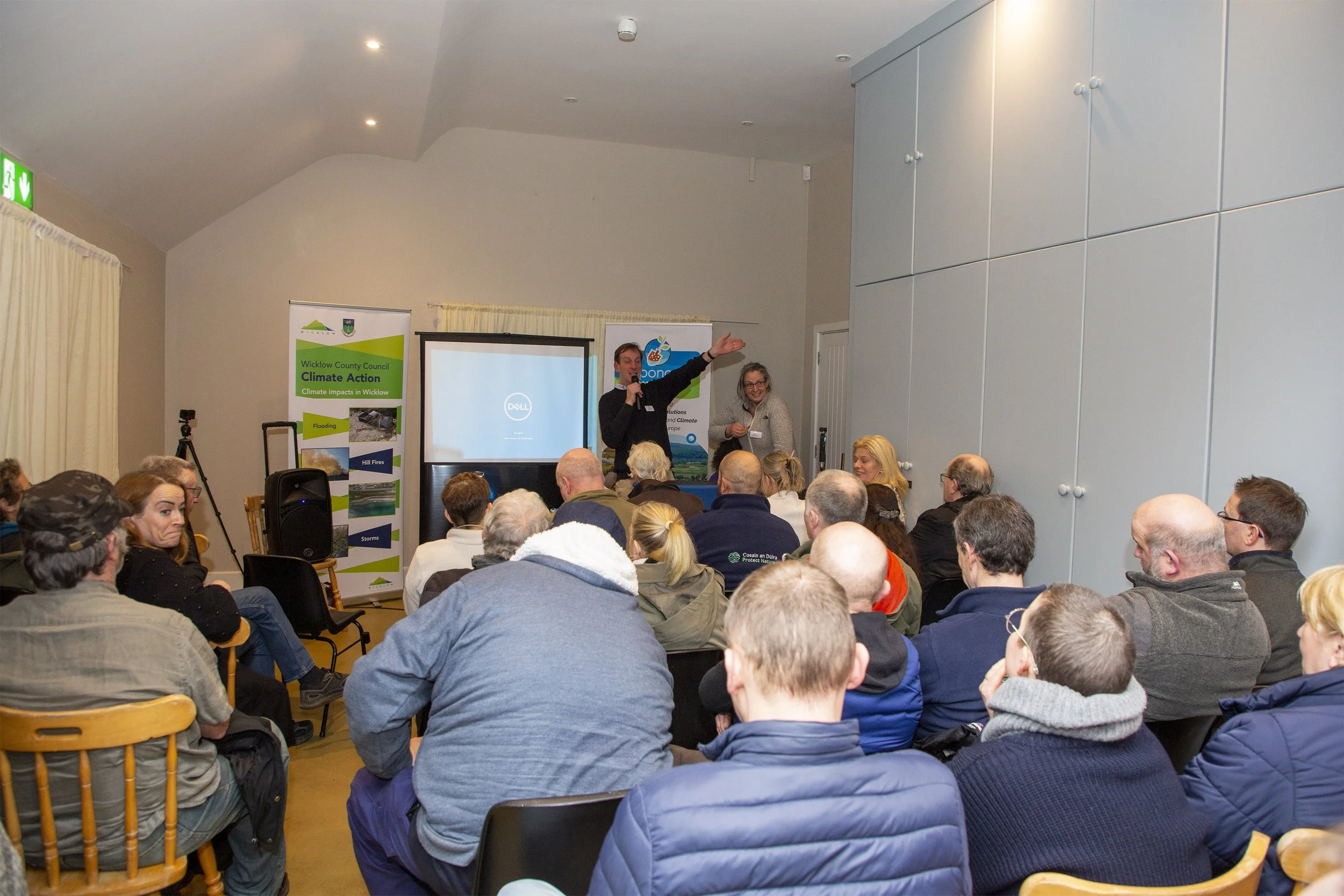

Community knowledge is key
The project was formally launched by Cathaoirleach of Wicklow County Council, Cllr. Melanie Corrigan, who emphasised the importance of community involvement in climate action.
Drawing on her background in upland farming, she highlighted the role of local knowledge in identifying effective responses to environmental challenges.
“All of us in the farming community are witnesses to our changing climate,” she said. “Our understanding of our land means we are best placed to identify the solutions and help to implement them.”
A European project with a local focus
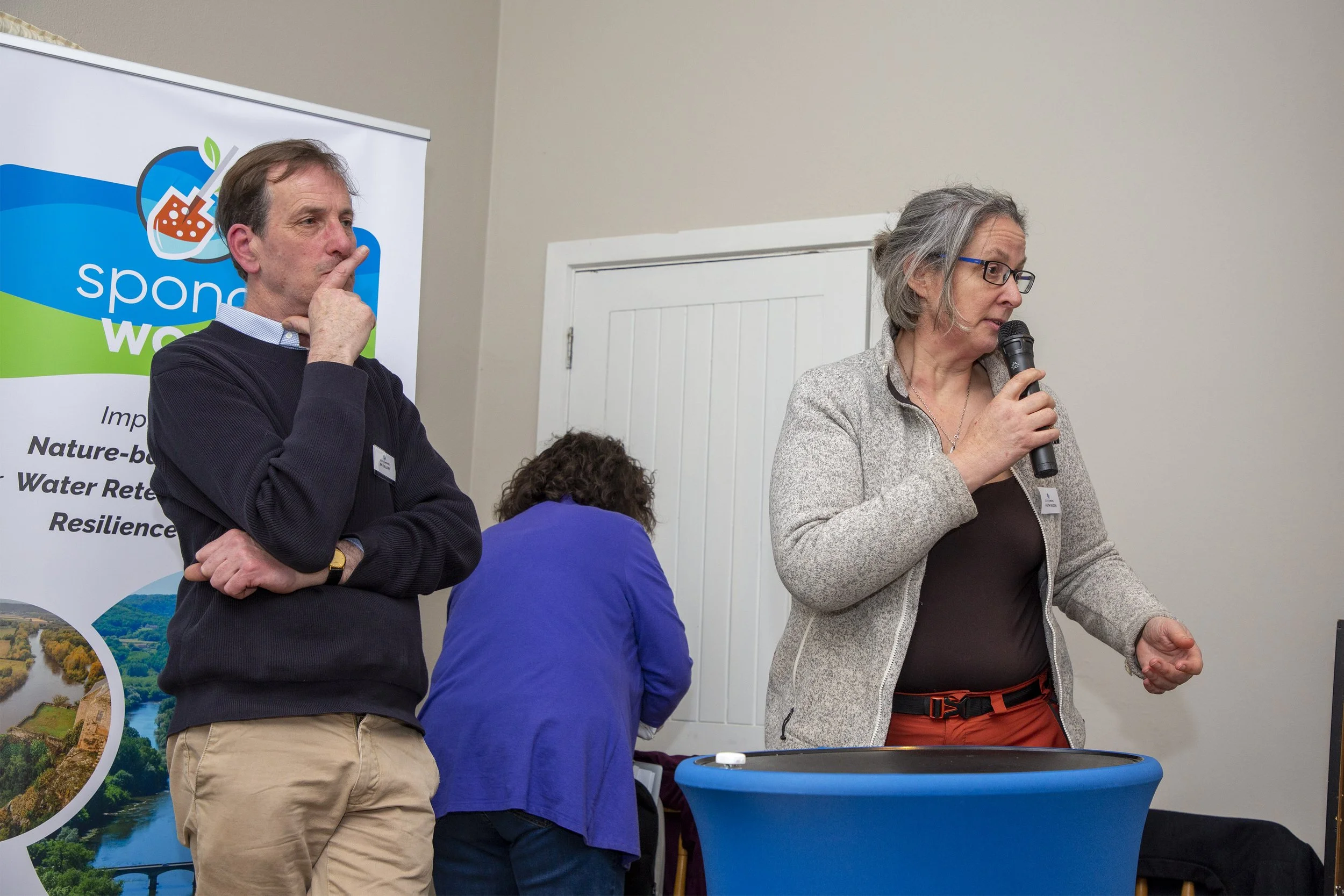
Jim Callery, Climate Action Officer with Wicklow County Council, introduced the Spongeworks project and outlined Wicklow’s role as an Associate Region within a wider European partnership stretching from Greece to Ukraine.
He explained why Aughrim in the Avoca catchment was selected as the study area and stressed that strong collaboration between local authorities, NGOs, landowners and communities will be essential to achieving positive outcomes.
Referencing the recent flooding during Storm Chandra, he highlighted the importance of developing practical, locally informed resilience measures across the catchment.
Working with nature to manage water
Professor Mary Bourke of the School of Geography at Trinity College Dublin gave an engaging presentation on how landscapes have changed over time and how climate change is affecting weather patterns, and a wonderful oversight of how catchments function naturally and practical sponge measures we can take.
“We are now living in climate change,” she told attendees. “Our weather patterns are beginning to show this, and we are increasingly experiencing weather extremes.”
Her talk explored how water moves through landscapes, particularly in relation to flooding and drought. She explained that nature-based solutions can help retain water in the landscape, slow its movement into rivers, reduce downstream flooding and maintain soil moisture during dry periods.
Professor Bourke emphasised that while engineered flood defences can play a role, working with natural systems is essential for building resilient landscapes.
Sharing local knowledge
Following the presentations, attendees took part in an interactive workshop, where they marked maps of the catchment and shared their experiences of recent floods as well as historical changes in the landscape. These discussions provided valuable insights into how water moves through the catchment and how local knowledge can help shape practical solutions.
Building resilience together
The event reinforced a central message of the Spongeworks project: building climate resilience requires partnership. Scientific research and engineering solutions are important, but lasting change depends on working closely with communities and understanding local landscapes.
The Chief Executive of Wicklow County Council Emer O’Gorman noted that the recent flooding had a devastating impact on the Aughrim community and highlighted the need to rethink how water is managed across the landscape. As Wicklow is particularly vulnerable to river flooding, nature-based solutions will be an important part of developing a more resilient response to climate change.
Looking ahead
Through the Spongeworks project, partners will explore how nature-based solutions can slow the flow of water through the catchment, helping to reduce flood risk and improve resilience to both flooding and drought.
The long-term aim is to demonstrate how these approaches work in practice, develop strategies for wider implementation, and scale them up across the landscape so they can make a meaningful difference for communities in Aughrim and across the wider Wicklow region.